Finding opportunities to make Azure work harder
Parallo began with an Azure Well-Architected Review of ZenContract’s cloud environment, looking for opportunities to improve its architecture, security and efficiency. Together, the teams identified five priority areas of work focused around two key objectives: cost optimisation and security.
One of the immediate opportunities was infrastructure spend. At the beginning of 2023, ZenContract was spending around $200 per day on its cloud infrastructure. Over the following months, Parallo reviewed how those resources were being used and identified areas where costs could be reduced without compromising performance.
That included identifying overspend on storage and optimising backups to avoid unnecessary duplication, introducing lifecycle policies to remove old and unused data, and finding resources such as VPN gateways and virtual machines that were no longer required. ZenContract also shifted to time-based Azure reserved instances to further optimise its infrastructure costs.
By September, daily infrastructure costs had fallen by 45%.
Turning cloud savings into greater security
The value of the optimisation work went beyond the immediate saving. Reducing unnecessary infrastructure spend gave ZenContract the ability to redirect resources towards another important priority: security.
The company introduced additional services to strengthen backup and disaster recovery and moved towards a geo-redundant architecture designed to reduce the risk of application downtime. For a SaaS business serving customers around the world, improving resilience was becoming increasingly important as the platform grew.
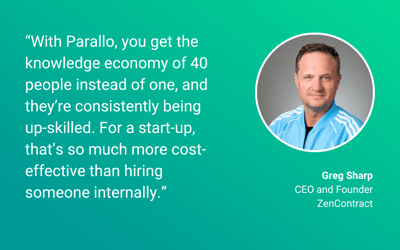
“Doing the cost optimisation work allowed us to reallocate resources to security. It gives us peace of mind that, if something does go wrong, we’ve got a plan. Your customers care just as much about how you respond in those scenarios.”
— Greg Sharp, CEO and co-founder, ZenContract
Keeping optimisation going as ZenContract scales
Cloud optimisation isn’t a one-off exercise. As applications, customer numbers and workloads change, an efficient environment today can quickly start accumulating unnecessary costs tomorrow.
Parallo continues to monitor ZenContract’s environment and meet with the team monthly to review progress, changes and opportunities for further optimisation. Machine learning is also used to analyse cloud spend over time, helping identify unexpected increases so the team can investigate the cause and adjust the environment where needed.
That ongoing visibility is particularly important as ZenContract works towards its next stage of growth. The company has plans to expand its integrations, develop its own API, introduce an additional revenue stream and increase its market reach. Its cloud infrastructure therefore needs to remain secure, highly available and capable of scaling alongside the business.
More time to focus on growth
For ZenContract, the result is not simply a lower Azure bill. It has access to ongoing cloud expertise without needing to build a dedicated capability internally, stronger security and resilience, and an environment that is continuously monitored and optimised as the company grows.
Most importantly, that means Greg and his team can keep their attention where it delivers the greatest value: developing the platform, finding new customers and growing the business.